Choosing the best water management system for hospitals
 Milvian AI teamFacilities and infrastructure intelligence
The best water management system for hospitals submeters each building, floor and major user, closes a live water balance so unaccounted loss is visible, monitors hot water loop temperatures continuously as evidence for the water management program, tracks RO, dialysis feed and STP performance, alerts on leaks and overnight flow, and verifies savings against a weather-normalized baseline.
Why hospitals are a hard case for water management
A hospital uses water in more ways than almost any other building. Domestic hot and cold water serve wards and clinics, sterile processing and endoscopy need treated water, dialysis units need RO water of a defined quality, kitchens and laundries draw heavily, and cooling towers and boilers take make-up around the clock. Many hospitals also run their own RO plant and sewage treatment plant.
Water safety sits on top of all of it. Hot water loops must stay hot enough to control Legionella growth, and stagnant dead legs are a risk in their own right. Water management programs under ASHRAE 188 and CDC guidance expect monitoring, not occasional spot checks.
Most hospitals still have one meter at the boundary. A leaking riser, a running fixture or an overflowing tank disappears into a monthly total, and nobody can say where the water went.
Hospitals that run their own RO and STP have a further problem. These plants are judged on recovery and treated water quality, yet their performance is often read by hand once a shift. A fouling membrane slowly sends more water to reject, and a struggling STP limits how much treated water can be reused for flushing, cooling towers or landscaping. The best water management system treats these plants as part of the same live picture.
What the best water management system for hospitals must do
| Requirement | Why it matters in hospitals | Question to ask a vendor |
|---|---|---|
| Submetering by building and user | The boundary meter cannot locate losses. | Can you meter buildings, floors, kitchens, laundry, towers and the RO plant separately? |
| Live water balance | Unaccounted loss is the leak signal. | Do you show supply against the sum of all metered uses in real time? |
| Hot water temperature evidence | Water management programs need continuous loop data. | Can you log hot water supply and return temperatures continuously by loop? |
| RO and dialysis feed monitoring | Feed, permeate, reject and TDS affect both quality and cost. | Do you track recovery and TDS in and out? |
| STP performance | Treated water quality and reuse depend on plant efficiency. | Can you monitor inlet, treated flow and efficiency? |
| Overnight and leak alerts | Leaks are cheapest to fix the night they start. | How do you alert on flow above the expected overnight pattern? |
| Weather-normalized baseline | Cooling tower and irrigation use swing with weather. | Do you baseline against degree days and price savings in our tariff? |
| Multi-site view | Health systems need every hospital on one method. | Can you rank hospitals by water use intensity? |
The categories hospital teams compare
- Traditional BMSMonitors some plant temperatures and pumps. It rarely sees submeters, closes a water balance or prices losses.
- Standalone water dashboardsTrend meter data clearly. Many lack temperature evidence, RO and STP performance or a balance.
- IoT leak sensorsSpot sensors detect water on the floor in plant rooms. They find leaks after the fact and cannot see losses inside pipes.
- CMMS and water safety logbooksHold flushing records, risk assessments and work orders. They depend on manual readings between visits.
- Water treatment contractorsExpert on chemistry and tower treatment. Their data usually stays in their own reports.
- Facility intelligence platformsFlow, temperature, RO, STP and balance on one live model, beside energy and air.
How to evaluate a water management system for a hospital
- Map the water systemTrace the incomer, storage tanks, risers, hot water plant and loops, kitchens, laundry, towers, RO and STP. Pull 12 months of bills.
- Agree the evidence the water team needsWith the water management team, list the temperatures and flows that the program relies on.
- Close the balance on one buildingFit clamp-on flow meters and temperature sensors on one building until supply equals metered use plus a small, explained loss.
- Watch nights and weekendsOvernight flow is where leaks and running fixtures show. Judge each vendor on what they find.
- Judge on verified resultsLosses named in volume and money, and temperature evidence the water team accepts.
Evaluation scorecard for hospital water management
| Criterion | Weight | What good looks like |
|---|---|---|
| Water balance | High | Live supply against metered uses, unaccounted loss shown |
| Temperature evidence | High | Continuous hot water loop data by loop |
| Leak and overnight alerts | High | Alerts with location and volume |
| Treatment plant performance | Medium | RO recovery, TDS and STP efficiency tracked |
| Verification | Medium | Weather-normalized baseline priced in your tariff |
| Integration | Medium | Reads BMS and existing meters, routes to CMMS |
| Portfolio view | Medium | Hospitals ranked by water use intensity |
| Data trust | Low | Sensor health and coverage per device |
Integration and data in a hospital water system
Clamp-on ultrasonic flow meters and strap-on temperature sensors avoid cutting into live hospital pipework, which matters for infection control and continuity. Existing smart meters and BMS points are read over Modbus or BACnet, and LoRaWAN carries battery sensors from risers and plant rooms without new cabling.
Findings route into the CMMS so a leak or a cold loop becomes a work order with evidence attached. The water management team keeps its own logbook and procedures, now supported by continuous data.
Ask about the evidence trail. When a loop temperature drops below the program's limit, the system should record when it started, how long it lasted, which loop and what was done about it. That record is what the water management team and accreditation surveyors will want to see. Device health matters here too: a temperature sensor with a flat battery must show as missing data, not as a compliant reading.
Compliance and reporting in hospital water
ASHRAE 188 and CDC toolkits describe water management programs for Legionella. NABH accreditation in India sets facility expectations, AWWA M36 gives a structure for water audits and loss accounting, and LEED and WELL reward measured water performance.
The water management system supplies continuous measured evidence. The hospital's water management team, accreditation bodies and auditors own the program and its conclusions.
Where Aqueduct fits
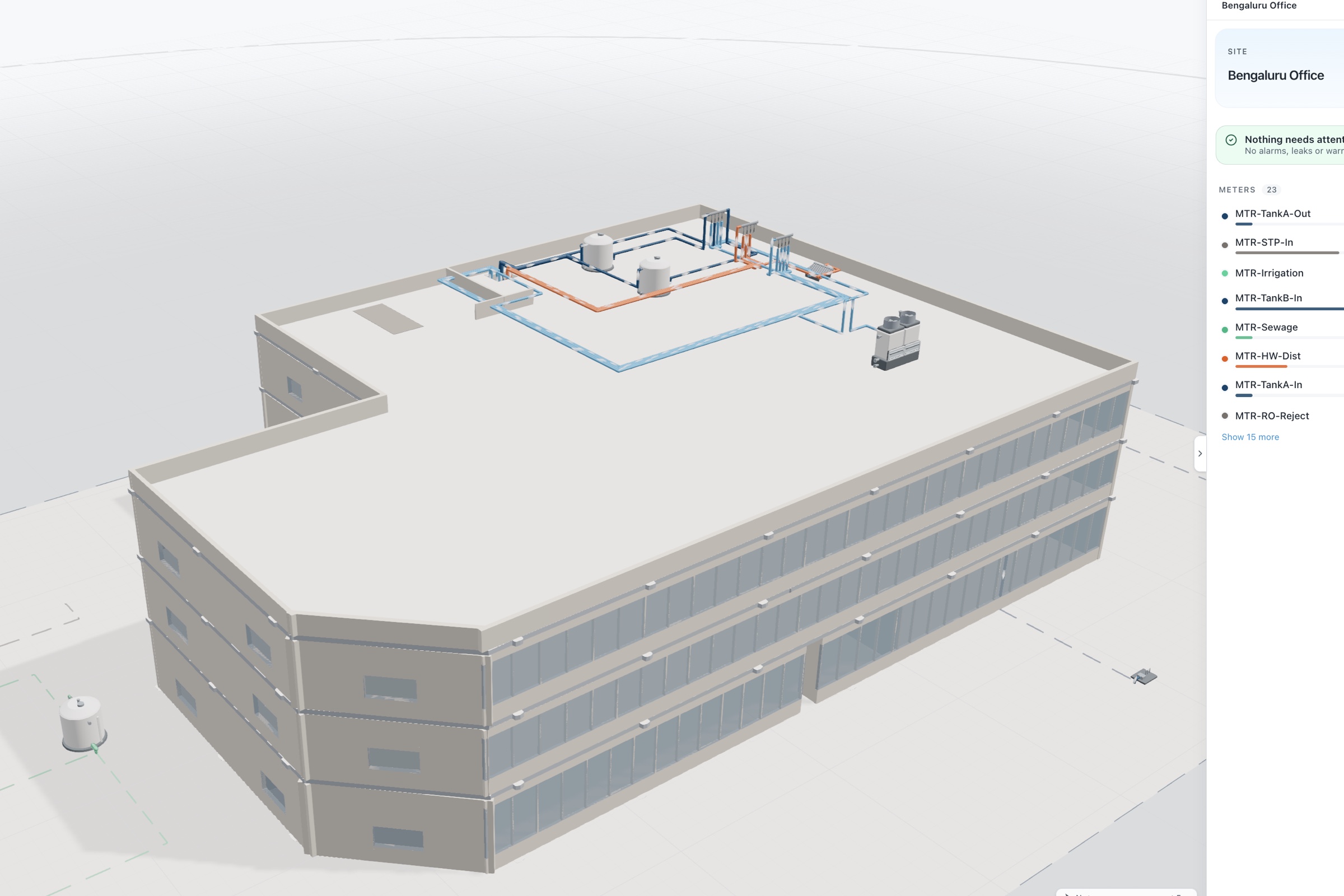
Aqueduct serves one of India's top hospital chains with 22 hospitals and 9 clinics. aQ Core maps each hospital as sites, floors, zones and devices. aQ WaterGuard builds a live water digital twin, block by block: tanks with levels, hot and cold distribution, each floor, the RO unit with feed, permeate, recovery and TDS, and the STP with inlet, treated flow and efficiency. The water balance equation shows main supply against every metered use, with unaccounted loss as its own term.
Baselines are built by regression on use and degree days, from uploaded bills on day one, and rate configuration prices every loss. Hospitals keep their BMS and CMMS. Where control is enabled, with owner approval, Smart Controls can act on approved pumps or valves through field devices or LoRaWAN relays, with every command logged.
A first engagement usually closes the water balance on one building and its hot water loops. Clamp-on meters and strap-on sensors go in without cutting pipe, the water management team agrees which temperatures matter, and the first unaccounted loss is narrowed down floor by floor. RO and STP performance follow, then further buildings and sites.