Best building management system software in 2026: a buyer guide written from the plant room
 Milvian AI teamFacilities and infrastructure intelligence

The best building management system software in 2026 reads the controllers you already own over BACnet and Modbus, meters energy, water and air at system level, baselines use against weather, finds faults in plain language, routes work to your CMMS and, where control is enabled with owner approval, acts with lockouts and a full command history. Anything less is a dashboard.
Why choosing BMS software is harder than it looks
Most buildings already have a building management system. It was specified by the mechanical engineer, installed by a controls contractor and commissioned years ago. It runs the schedules and setpoints for air handlers, chillers, boilers and VAV boxes, and for that job it is usually fine. The trouble starts when the owner asks it to do something else: tell me what each system costs, prove the last project saved anything, compare this building with the other twelve, or warn me before the chiller fails.
Those questions sit outside what a traditional BMS was designed to answer. Its data is organized around control points, not meters. Trend logs are short, often a few weeks, and live on a local server. Water is rarely in it at all, and air quality only where a sensor happened to be wired into a zone.
So the buying question in 2026 is not really which BMS has the nicest graphics. It is which software turns the equipment and controllers you already own into measured, verified decisions across every site, and acts safely when it should. That changes the criteria, and it changes which category of product you should be looking at.
What the best building management system software must do
| Requirement | Why it matters | Question to ask a vendor |
|---|---|---|
| Read existing controllers over open protocols | Most owners cannot afford to rip out working controllers, and should not have to | Which BACnet objects and Modbus registers can you read today, and who maps the points |
| Meter energy, water and air at system level | Control points tell you what a valve was told to do, not what the system consumed | Can you show chiller, AHU, floor and line level consumption, not just a site total |
| Weather-normalized baselines | Without one, a mild year looks like a successful project | How do you build the baseline, and can I get one on day one from utility bills |
| Fault detection with a plain-language cause | A list of alarms is not a diagnosis, and technicians ignore noise | Show me a fault, the evidence behind it and the recommended fix |
| Control with safeguards | Software that can send commands can also short cycle a compressor | What lockouts, approval steps and command history do you keep |
| Portfolio view across sites | Owners run many buildings and need to know which one needs attention | How do you rank sites fairly when they differ in size, use and climate |
| Work routed to the CMMS | Findings that do not become work orders do not get fixed | Which CMMS do you integrate with, and what does a ticket contain |
| Verified savings | Finance funds what it can verify, not what is estimated | How is each saving measured, and when does it roll into the new baseline |
The categories of tools buyers compare
- Traditional BMS or BASDoes well: reliable, local, real-time control of HVAC sequences, written by people who know the equipment. Where it stops: data is organized for control, trend storage is short, water and portfolio views are usually missing and each site is its own island.
- Standalone EMS dashboardsDoes well: clear charts of main meter energy, often quick to deploy. Where it stops: limited sub-metering, little or no fault diagnosis, no control, and savings shown as raw before and after comparisons.
- IoT monitoring platformsDoes well: cheap wireless sensors, fast installation and alerts on thresholds. Where it stops: readings without a model of the building, so a temperature alert tells you something is wrong but not what or why.
- CMMS or EAMDoes well: work orders, asset registers, preventive maintenance schedules and parts. Where it stops: it records the work, it does not watch the equipment, so faults are found when someone reports them.
- Utility bill management servicesDoes well: invoice processing, tariff audits and portfolio spend reporting. Where it stops: monthly data, a month late, with no view of which system moved.
- Spreadsheets plus consultantsDoes well: expert analysis for an audit, a retrofit business case or a certification. Where it stops: a snapshot in time that goes stale the week the consultant leaves.
- Facility intelligence platformsDoes well: one data layer across meters, sensors and existing controllers, digital twins of real systems, weather-normalized baselines, diagnosis, CMMS routing and control with safeguards. Where it stops: it depends on good instrumentation, so a site survey and some metering are usually part of the project.
How to evaluate building management system software
- Walk the site and list what you haveRecord controllers, protocols, meters, existing sensors and who holds the BMS credentials. Note which systems have no measurement at all. This list decides the scope more than any feature sheet.
- Write down three questions you cannot answer todayFor example: what does the chiller plant cost per month, why did water use rise in March, which building is drifting.
- Ask for a live demo on real dataSynthetic demos always look clean. Ask to see a site with gaps, a sensor that stopped reporting and a fault that was found and closed.
- Run a scoped pilot with a measured resultPick one building or one system, agree the baseline method before you start and agree what counts as success. A pilot without a pre-agreed measurement is a demo that lasts three months.
- Review security and control governanceBring IT in early. Agree who can send commands, what needs approval and how every command is logged before any control is switched on.
An evaluation scorecard you can copy
| Criterion | Weight | What good looks like |
|---|---|---|
| Integration with existing controllers | High | Reads your BACnet and Modbus devices without replacing them, with point mapping included in scope |
| Measurement depth | High | System level metering for energy and water, plus air quality where people are |
| Baselining and verification | High | Regression on weather and history, available from bills on day one, savings verified at the meter |
| Diagnosis quality | High | Faults explained with evidence and a recommended action, routed to your CMMS |
| Control safeguards | Medium | Owner approval, lockouts against short cycling and a complete command history |
| Portfolio reporting | Medium | Sites ranked against their own expected use, normalized by area or occupancy |
| Data health | Medium | Per device connection and battery status, with the device located on a floor plan |
Integration and data: keep, replace or overlay
The single most expensive mistake in this category is replacing controllers that work. If the existing BMS runs its sequences well, read it. BACnet and Modbus give a modern platform access to the points it needs, and a field device network controller can sit alongside the existing system without disturbing it.
Where there is no BMS, or where the BMS has no visibility of a system, add measurement directly. LoRaWAN meters and sensors install quickly in occupied buildings because they need no new cabling, and LoRaWAN relay switches can handle simple loads such as exhaust fans or lighting circuits. Complex equipment such as AHUs, RTUs, chiller plants and VAV boxes are reached through Modbus or BACnet.
Some sites will also have SCADA for water treatment or process systems, and almost every owner has a CMMS. The right software reads the first and writes into the second. It does not ask the maintenance team to move to a new work order system.
Compliance and reporting
Building owners face more reporting each year: benchmarking ordinances, building performance standards such as Local Law 97 in New York City, investor frameworks such as GRESB, corporate disclosure under CSRD, and energy management systems under ISO 50001. Design standards such as ASHRAE 90.1 and ventilation standards such as ASHRAE 62.1 set the expectations a building is measured against.
No software makes a building compliant. What good software does is supply measured, timestamped evidence, organized by site and system, so the people who file the report or perform the audit spend their time on judgment rather than chasing data. Ask every vendor to show you an export of the data a benchmarking submission or an ISO 50001 energy review would actually need.
Where Aqueduct fits
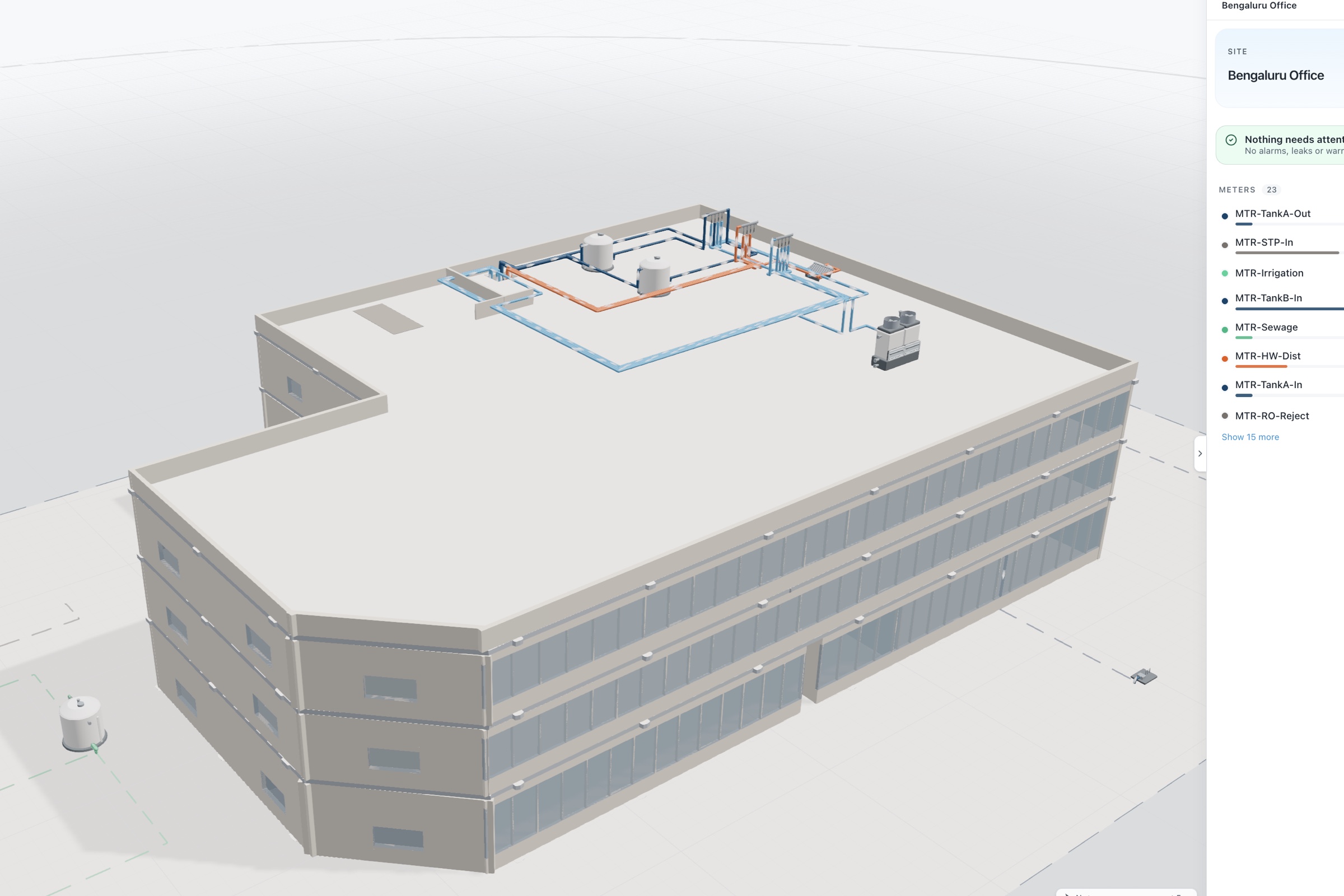
Aqueduct is a facility intelligence platform from Milvian AI. aQ Core holds the site, floor, zone and device model and stores every reading. aQ EnergySmart, aQ WaterGuard and aQ AirSafe each follow the same path: site map, portfolio, digital twin and analytics. The digital twins are built block by block to match the real installation, from the electrical single line to the water balance equation to the components of an individual rooftop unit.
Baselines are built by regression on historical use plus cooling and heating degree days. Upload utility bills and results are available from day one, and rate configuration turns the difference into money. Faults are explained in plain language and routed to your CMMS.
Smart Controls acts through LoRaWAN relay switches or through Modbus and BACnet field devices, where control is enabled, with owner approval, with lockouts that protect equipment and a command history that shows what was sent and whether it ran. There are three ways in: keep your BMS and read it, replace it, or build Aqueduct in at design stage. Aqueduct runs at 275+ sites in 21 countries.