The best water management system for commercial real estate portfolios
 Milvian AI teamFacilities and infrastructure intelligence

The best water management system for commercial real estate submeters base building and tenant water, alerts on overnight flow and leaks before they cause damage, meters cooling tower make-up and blowdown, ranks every building by water use intensity against a weather-normalized baseline, bills tenants from measured use and supplies traceable figures for GRESB, LEED and ENERGY STAR.
Why commercial real estate is a hard case for water management
In an office or mixed-use building, water is spread across restrooms on every floor, tenant kitchens, cooling towers, irrigation, fitness centers and retail units. Most buildings have one utility meter. A running toilet on the eighth floor, a stuck fill valve on a tower or an irrigation zone watering in the rain all look the same: a slightly higher bill a month later.
The bigger risk is damage. A failed fitting above a tenant's ceiling or a burst pipe in an empty building over a weekend can cost far more than the water itself, in repairs, disruption and insurance claims.
Across a portfolio, the problem multiplies. Asset managers need to compare buildings of different size and climate fairly, recover tenant water costs, and report water figures to investors and certification programs. A monthly bill per building cannot do any of that.
Cooling towers deserve special attention in many commercial buildings. They can be the largest single water use on the site, and they are often run by a water treatment contractor on a fixed blowdown schedule. Make-up water lost to a stuck float valve or excessive blowdown looks like normal operation unless someone is metering it. In some cities, sewer charges are credited for evaporated water, but only if the volume is metered.
What the best water management system for commercial real estate must do
| Requirement | Why it matters in CRE | Question to ask a vendor |
|---|---|---|
| Base building and tenant split | Landlord and tenant water need to be separated to recover cost. | Can you meter tenant supplies and split shared meters fairly? |
| Overnight flow alerts | An empty building should use almost no water at night. | Do you alert on flow above the expected overnight pattern, with a location? |
| Leak detection that prevents damage | Damage costs more than water. | How quickly do you alert, and can you combine flow with spot leak sensors? |
| Cooling tower metering | Towers are often the largest single use. | Do you meter make-up and blowdown and show cycles? |
| Water use intensity ranking | Buildings must be compared fairly. | Do you rank by gallons per square foot or per visitor, against a baseline? |
| Tenant billing | Area-based recovery leaves the landlord paying. | Can you bill tenants from measured use with tenant-only views? |
| Reporting evidence | GRESB, LEED and ENERGY STAR ask for measured water. | Can every reported figure be traced to a meter? |
| Day-one baseline | Asset plans cannot wait a year. | Can we upload bills and get a weather-normalized baseline immediately? |
The categories property teams compare
- Traditional BMSMonitors pumps and some plant. Rarely sees submeters or tenant use, and does not price losses.
- Standalone water dashboardsTrend meter data across buildings. Many lack overnight analysis, tenant billing or tower depth.
- Spot leak sensorsDetect water on the floor under a tank or in a riser. Good insurance, but they find leaks after water escapes, and only where placed.
- Utility bill servicesTrack and pay water bills across accounts. They see problems a month late with no location.
- CMMSRuns work orders for plumbing faults. It records the fix, not the volume lost.
- Facility intelligence platformsFlow, balance, tenant billing and reporting across the portfolio on one model, beside energy and air.
How to evaluate a water management system for a portfolio
- Pick representative buildingsChoose two or three buildings with different ages, tower setups and tenant mixes. Pull 12 months of water bills.
- Map meters and leasesList existing meters, which are shared, and how tenants are charged for water today.
- Fit flow meters on risers and towersClamp-on meters on the main, key risers and tower make-up and blowdown, without shutting water off.
- Watch the nightsOvernight and weekend flow shows running fixtures and leaks. Judge vendors on what they find and how fast.
- Judge on money and riskVolume and cost of losses found, tenant cost recovered, and alerts raised before damage.
Evaluation scorecard for CRE water management
| Criterion | Weight | What good looks like |
|---|---|---|
| Leak and overnight detection | High | Alerts with a location, raised the night a leak starts |
| Tenant recovery | High | Tenants billed from measured use, shared meters split |
| Portfolio ranking | High | Water use intensity against a weather-normalized baseline |
| Cooling towers | Medium | Make-up, blowdown and cycles measured |
| Reporting evidence | Medium | Traceable figures for GRESB, LEED and ENERGY STAR |
| Installation | Medium | Clamp-on meters, no shutdowns, no tenant disruption |
| Integration | Medium | Reads BMS and existing meters, routes to CMMS |
| Data trust | Low | Sensor health and coverage visible |
Integration and data across a portfolio
Clamp-on ultrasonic flow meters go on mains, risers and tower lines without cutting pipe or shutting water off. Existing smart meters and BMS points are read over Modbus or BACnet, and LoRaWAN carries battery sensors from basements and roofs without new cabling.
Bills come in by upload or utility feed. Tenant billing exports to the accounting system, and alerts route to the property team's CMMS or on-call staff. Ask how the system tells a quiet meter from a meter that has stopped reporting, because a dead meter on a riser looks exactly like a building with no leaks.
Alert design matters as much as metering. Each building has its own pattern: an office with a gym that opens at six, a mixed-use tower with a restaurant that cleans at midnight. Alerts should learn that pattern rather than use one threshold for the whole portfolio, or the team will start ignoring them.
Compliance and reporting for CRE water
GRESB asks for water consumption and coverage across the portfolio. ENERGY STAR Portfolio Manager tracks water alongside energy. LEED, BREEAM and WELL reward measured water efficiency. In Europe, CSRD brings water into disclosure, and AWWA M36 offers a structure for water loss accounting.
The water system supplies measured, traceable figures. Owners, verifiers and certification bodies decide the outcome.
Where Aqueduct fits
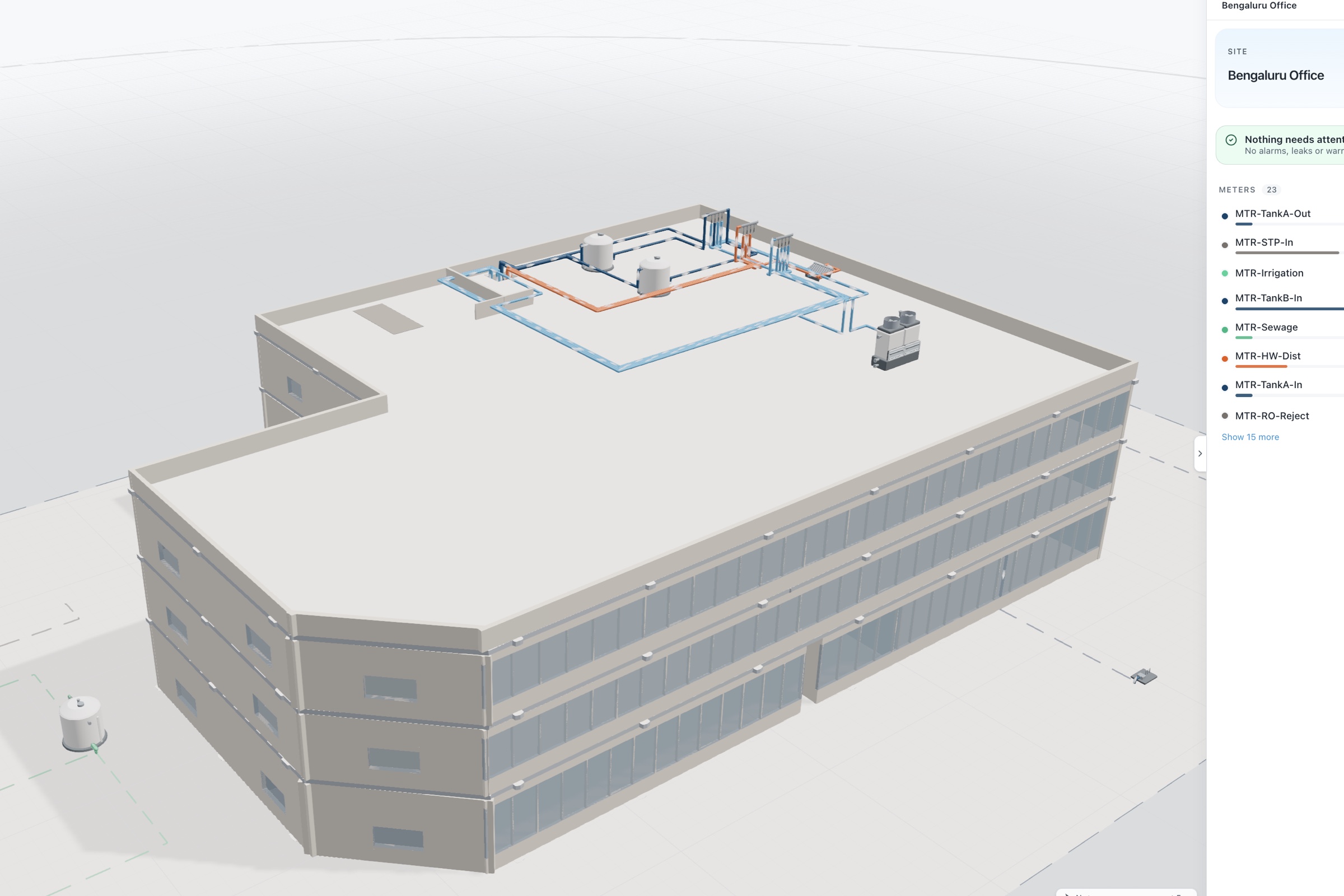
Aqueduct serves a commercial real estate developer with 20M+ sq ft. aQ Core holds every building as sites, floors, zones and devices. aQ WaterGuard builds a live water digital twin per building, with a water balance that shows main supply against each floor, the fire system and other metered uses, and unaccounted loss as its own term. The portfolio view ranks buildings by water use intensity per square foot or per visitor against a weather-normalized baseline, available on day one from uploaded bills.
Billing Management bills tenants from measured use and validates utility invoices. Owners keep the BMS, replace failed meters or build in metering at design. Where control is enabled, with owner approval, Smart Controls can act on approved valves or irrigation through field devices or LoRaWAN relays, with command history for every action.
A first engagement usually covers two or three buildings. Bills are uploaded for day-one baselines, clamp-on meters go on mains, risers and towers, and overnight patterns form within weeks. The first findings are typically running fixtures and tower make-up losses, each located and priced, before tenant billing and the wider portfolio follow.