The best EHS monitoring software for hospitals: environment of care evidence that holds up
 Milvian AI teamFacilities and infrastructure intelligence
The best EHS monitoring software for a hospital measures the environment of care continuously: temperature, humidity, pressure relationships and air quality in critical spaces, hot and cold water loop temperatures for the water management program, and utility performance. It keeps a timestamped record with sensor health, alerts the right team while there is time to act, and exports evidence for surveys without replacing the hospital's EHS or compliance system.
Why hospitals are a hard case for EHS monitoring
A hospital is judged on its environment as much as its care. Operating rooms, isolation rooms, sterile processing, pharmacy and laboratories have temperature, humidity, air change and pressure requirements set out in standards such as ASHRAE/ASHE 170. Hot and cold water systems have to be managed against Legionella under a water management program, often built on ASHRAE 188. Accreditation surveys, whether Joint Commission environment of care standards in the United States or NABH in India, ask the hospital to show it monitors these conditions and acts when they drift.
Most hospitals evidence this with a patchwork. A BMS that controls air handlers but logs only what its programmer chose. Paper or spreadsheet logs filled in on rounds. Monthly water temperature checks at sentinel outlets. A separate pharmacy fridge system. When a surveyor asks to see pressure in an isolation room over the last quarter, someone spends a day assembling an answer from three systems and finds the gaps as they go.
The hospital's EHS or compliance software handles policies, risk assessments, incidents, rounds checklists and corrective actions. What it cannot do on its own is measure a room. The monitoring layer this guide covers is the one that does, continuously and tied to the right room, then hands the evidence to the people who own each standard.
What the best EHS monitoring software for hospitals must do
| Requirement | Why it matters in a hospital | Question to ask a vendor |
|---|---|---|
| Monitor critical spaces continuously | Pressure, temperature and humidity drift between rounds, and surveys ask for the history | Which parameters do you read per room, and at what interval? |
| Tie every reading to a room | Evidence must name the operating room or isolation room it relates to | How are sensors mapped to floor, zone and room? |
| Support the water management program | Loop temperatures and stagnant outlets are Legionella control points | Can you trend hot and cold loop temperatures and flag low-use outlets? |
| Alert with context | A pressure reversal in an empty room is not the same as one during surgery | Can alerts consider occupancy and duration, and who receives them? |
| Show data quality | A silent gap in an isolation room record is a finding | Is sensor health visible per device and in the export? |
| Keep deviations with their closure | Surveyors want to see what happened after a drift | Can a deviation carry its cause and closure in the record? |
| Read the existing BMS | Air handlers already report many points | Do you read BACnet and Modbus without changing the BMS? |
| Export by survey period | Evidence is requested for defined periods and spaces | What does an export for one space over a quarter contain? |
| Stay out of clinical decisions | Infection prevention and engineering own room conditions | What do you leave to our EHS system and clinical teams? |
The tools hospital buyers compare, and where each one stops
- EHS management suitesStrong at incidents, near misses, permits to work, audits and inspections, training records, chemical inventories and corrective actions. They hold the workflow and the sign-offs. Most rely on people typing in readings, so environmental data arrives late, sampled or not at all.
- Environmental monitoring and lab servicesAccredited sampling and lab analysis remain the reference for regulated parameters. They are precise on the day, but a quarterly or monthly sample says nothing about the other days.
- BMS, SCADA and historiansGood at running equipment and storing tags. They were built for control engineers, so the data rarely reaches EHS in a form that answers an evidence question, and points outside the controls scope are not covered.
- Standalone sensor dashboardsQuick to deploy for one parameter, often air. They tend to stop at the chart: no water or energy balance, no baseline, no link to a work order, and a new login for every vendor.
- Spreadsheets plus consultantsFlexible and familiar, and consultants bring judgment. The data is assembled at report time, which is when gaps are discovered and cannot be filled.
- Facility intelligence platformsContinuous measurement of air, water and energy on one data layer, with baselines, alerts, digital twins of the systems and exportable records. They turn room conditions and water temperatures into a record surveyors can read. They do not replace the EHS suite's workflows, and they should say so.
How to evaluate environment of care monitoring
- Map the spaces and their standardsList every operating room, procedure room, isolation room, sterile store, pharmacy and lab, with the parameters and limits your hospital has adopted.
- Review how each is evidenced todayBMS logs, round sheets, fridge loggers and water checks. Note which are continuous, which are sampled and which are missing.
- Walk the plant and the floorsAir handlers serving critical spaces, hot water plant and loops, and the rooms themselves. Check network coverage and where wireless sensors can sit.
- Pilot one departmentTheatres or an isolation ward is the usual choice. Agree alert routes with engineering and infection prevention first.
- Run a mock survey on the pilot dataAsk for one room's history over the pilot period, with deviations and their closure. If it takes more than minutes, keep looking.
Environment of care monitoring scorecard
| Criterion | Weight | What good looks like |
|---|---|---|
| Critical space coverage | 25% | Every space with a standard has continuous pressure, temperature and humidity where required |
| Water program support | 15% | Loop temperatures and low-use outlets trended and flagged |
| Alerting and closure | 20% | Duration and occupancy aware, routed to named teams, closure recorded |
| Data quality | 15% | Per-sensor health shown, gaps flagged in exports |
| BMS and CMMS integration | 15% | BMS read, work orders routed to the CMMS |
| Clear scope | 10% | Leaves policies, rounds and incidents in the EHS system |
Integration and data in a hospital
Hospitals rarely replace a BMS for monitoring, and they should not have to. The air handlers serving critical spaces already expose points through BACnet or Modbus. A monitoring layer reads those, then adds what is missing: room pressure and humidity sensors in spaces the BMS does not cover, wireless air quality sensors in waiting areas and staff spaces, and temperature sensors on hot water loops and sentinel outlets.
Wireless LoRaWAN sensors matter in a live hospital because they can be fitted without cutting into ceilings above clinical areas. Each sensor should report its own connection and battery health, so engineering knows which device to replace before a gap opens in the record.
Findings route to the systems that own them. An air handler fault goes to the CMMS as a work order. A sustained pressure reversal is escalated to engineering and infection prevention under the hospital's own procedure and, where it meets the criteria, logged in the EHS system with the measured record attached.
Compliance and reporting in hospitals
- Environment of care surveysA continuous, room-level record of conditions, deviations and closures supports Joint Commission environment of care and NABH facility standards. The surveyor decides.
- Ventilation standardsASHRAE/ASHE 170 sets requirements for health care spaces. Continuous data shows whether rooms hold them in operation, not just at commissioning.
- Water management programLoop and outlet temperature trends give the water management team evidence instead of spot checks. The program itself stays with the team.
- Energy and sustainabilityMetered, weather-normalized energy supports ISO 50001 and ENERGY STAR benchmarking, kept separate from clinical evidence.
Where Aqueduct fits
Aqueduct is a facility intelligence platform, not a hospital EHS or compliance management suite. It does not manage policies, rounds, incidents or corrective action workflows. It supplies the continuous environment of care evidence those workflows need.
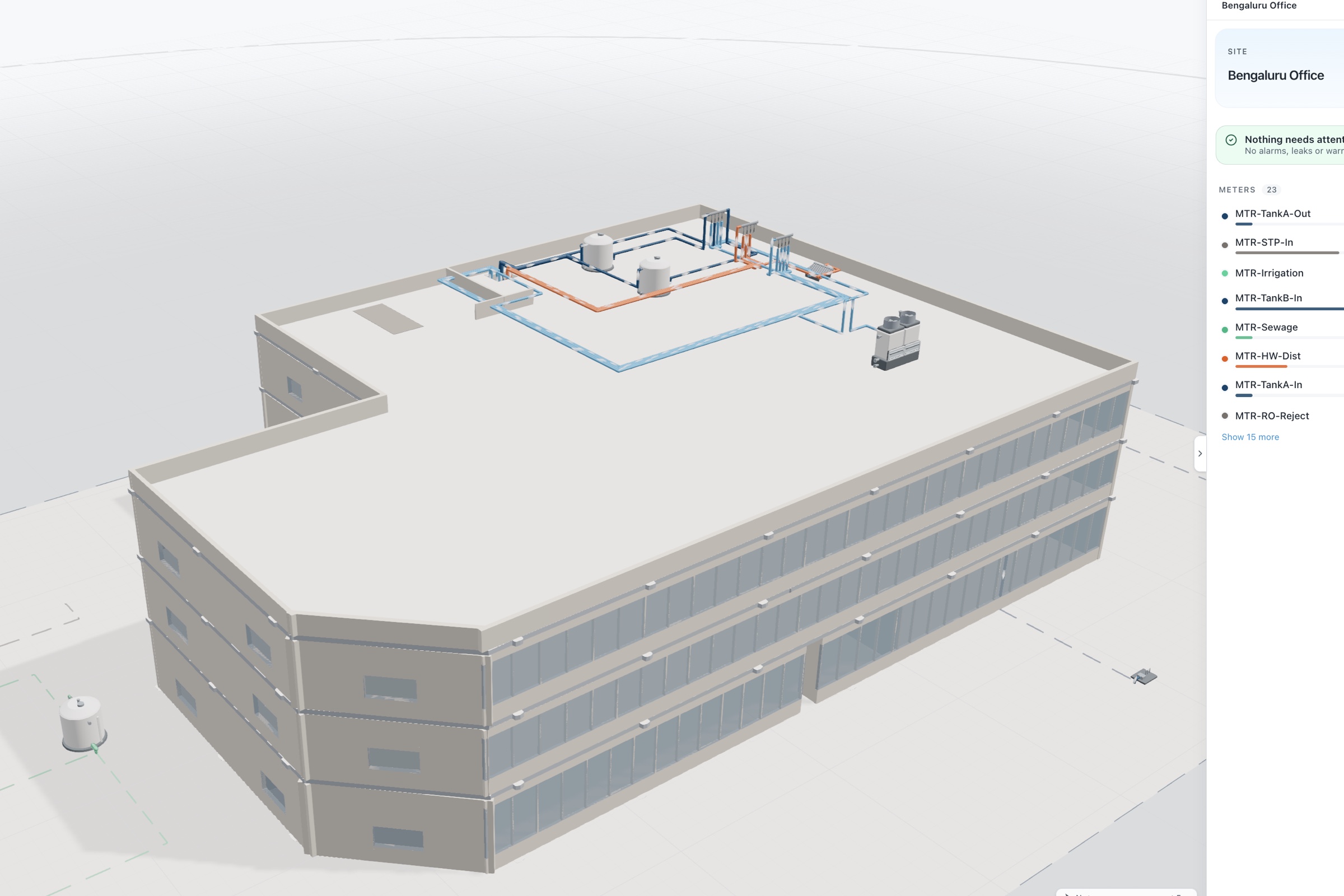
aQ AirSafe monitors temperature, humidity, CO2 and other air parameters per zone and overlays them with occupancy, so a drift during use stands out from one in an empty room. aQ WaterGuard trends hot and cold loop temperatures and flow. aQ Assurance keeps temperature and pressure records, deviations with closure, and exports for any assessment period; your team files and the surveyor decides. aQ Core maps every sensor to a floor, zone and room with sensor health visible, and aQ EnergySmart handles the plant.
Aqueduct serves one of India's top hospital chains, with 22 hospitals and 9 clinics. Hospitals keep their BMS and read from it, replace an end-of-life system, or build monitoring into a new wing. Where control is enabled, with owner approval, Smart Controls acts only outside clinical spaces unless engineering and infection prevention agree otherwise, and every command is logged.