The best building management system for commercial real estate: a buyer guide for owners and operators
 Milvian AI teamFacilities and infrastructure intelligence

The best building management system for commercial real estate reads the BMS in every building, meters base building and tenant use separately, bills tenants from sub-meters, baselines each asset against weather, ranks the portfolio fairly and produces the evidence LL97, building performance standards and GRESB ask for. Where control is enabled with owner approval, it also trims after-hours HVAC with a full command history.
Why commercial real estate is a hard case for a BMS
A commercial building serves two masters. The owner pays for the base building: central plant, common areas, lobbies, lifts and the air that reaches tenant floors. Tenants pay for what happens inside their space and expect comfort on their own hours. The BMS sits in the middle, usually installed by one contractor, run by a property management firm and changed by whoever was last on site.
That split creates the classic problems. After-hours HVAC requests are granted by phone and never switched off. Tenant electricity is recovered by area share rather than by measurement, so a heavy user is subsidized by a light one. The chiller plant runs to a schedule written for the building's original tenants, not today's occupancy. Water in cooling towers, restrooms and landscape irrigation is barely watched at all.
Above the building sits the portfolio. An owner or REIT has many assets, often with different BMS manufacturers, different property managers and different climates. Investors and regulators want comparable figures across all of them, and lenders increasingly ask about energy performance. A single building's BMS was never designed to provide that.
What the best BMS for commercial real estate must do
| Requirement | Why it matters in commercial real estate | Question to ask a vendor |
|---|---|---|
| Read every BMS in the portfolio | Assets come with different controls manufacturers and contractors | Can you read all of my existing systems over BACnet or Modbus without replacing them |
| Separate base building from tenant use | Recovery, NOI and lease terms depend on who used what | How do you meter and attribute base building and tenant consumption |
| Bill tenants from sub-meters | Area-based recovery leaves money on the table and creates disputes | Can tenants see their own share while the landlord sees the whole meter |
| Control after-hours HVAC | Out-of-hours requests are a quiet, recurring cost | How are after-hours schedules applied, approved and logged |
| Weather-normalized baselines per asset | Asset managers need to know whether a building improved or the weather changed | Can I get a baseline on day one from utility bills |
| Rank the portfolio fairly | Raw totals favor small buildings and punish busy ones | How do you normalize by floor area and occupancy |
| Validate utility bills | Supplier errors are common and rarely checked | Can you compare invoices with metered consumption |
| Evidence for LL97, BPS and GRESB | Reporting deadlines arrive whether the data is ready or not | What export do you produce for benchmarking and investor reports |
The categories of tools CRE buyers compare
- Traditional BMS from controls manufacturersStrong, local control of central plant and floors. Stops at the building boundary, rarely covers tenant billing or water and keeps short trend histories.
- Utility bill management servicesGood at processing invoices across a large portfolio and reporting spend. Monthly data with no view inside the building.
- Tenant billing and submetering servicesUseful for recovery and invoicing. Usually separate from energy analytics and controls, so the meter data is not used to run the building better.
- IoT and tenant experience platformsGood for occupancy, comfort feedback and amenities. Typically shallow on plant, metering and verification.
- ESG reporting softwareHelpful for assembling disclosures. Relies on the data it is given, which is often estimated.
- Facility intelligence platformsOne data layer across BMS, meters and sensors in every asset, with tenant billing, baselines, diagnosis, control and reporting from the same data. Needs a metering survey at the start.
How to evaluate a BMS for a commercial portfolio
- Start with the billsUpload 12 months of utility bills for every asset. A weather-normalized baseline from bills shows which buildings are drifting before any hardware is bought.
- Survey two or three representative buildingsPick a new asset, an older one and a problem one. Record controllers, protocols, meters and tenant metering arrangements.
- Agree the questions with asset managementFor example: which buildings miss their emissions limits, how much after-hours HVAC costs, how much tenant electricity is unrecovered.
- Pilot on one building with a measured targetAgree the baseline and what counts as success before the pilot starts, then measure against it.
- Scale by templateOnce one building works, repeat the same metering and reporting design across similar assets so the portfolio is comparable.
Evaluation scorecard for commercial real estate
| Criterion | Weight | What good looks like |
|---|---|---|
| Multi-vendor BMS integration | High | Reads every existing system over open protocols |
| Tenant metering and billing | High | Dedicated and shared meters, landlord and tenant views, anomalies by tenant |
| Baselines and verification | High | Weather-normalized per asset, available from bills, verified at the meter |
| Portfolio ranking | High | Assets ranked against their own expected use, normalized by area |
| Control with governance | Medium | After-hours and setpoint control with approval, lockouts and command history |
| Reporting exports | Medium | Data ready for ENERGY STAR, LL97, BPS and GRESB |
| Water coverage | Medium | Cooling towers, restrooms and irrigation metered and balanced |
Integration and data
In commercial real estate, keeping the BMS is usually the right starting point. Most office and mixed-use buildings have BACnet controllers that can be read without disturbing the property manager's sequences. Electricity meters and tenant sub-meters often speak Modbus, and LoRaWAN meters fill gaps in older buildings without opening ceilings in occupied tenant space.
The CMMS used by the property management firm stays in place and receives findings as tickets. Where a building's controllers are at end of life, replacement can be scheduled asset by asset, with the new system read by the same platform so the portfolio view never breaks. New developments are the moment to build metering and control points in from design.
Compliance and reporting in commercial real estate
Commercial owners carry more reporting than almost any other sector. Local Law 97 sets emissions limits for large buildings in New York City, and other cities and states have adopted building performance standards. Benchmarking through ENERGY STAR Portfolio Manager is required in many jurisdictions. Investors ask for GRESB submissions, and European portfolios face CSRD. Certifications such as LEED, WELL and BREEAM ask for measured operational performance.
Each of these needs the same thing: consistent, measured consumption per asset, with gaps explained. A platform supplies that evidence. The owner, the consultant or the assessor makes the filing and the judgment.
Where Aqueduct fits
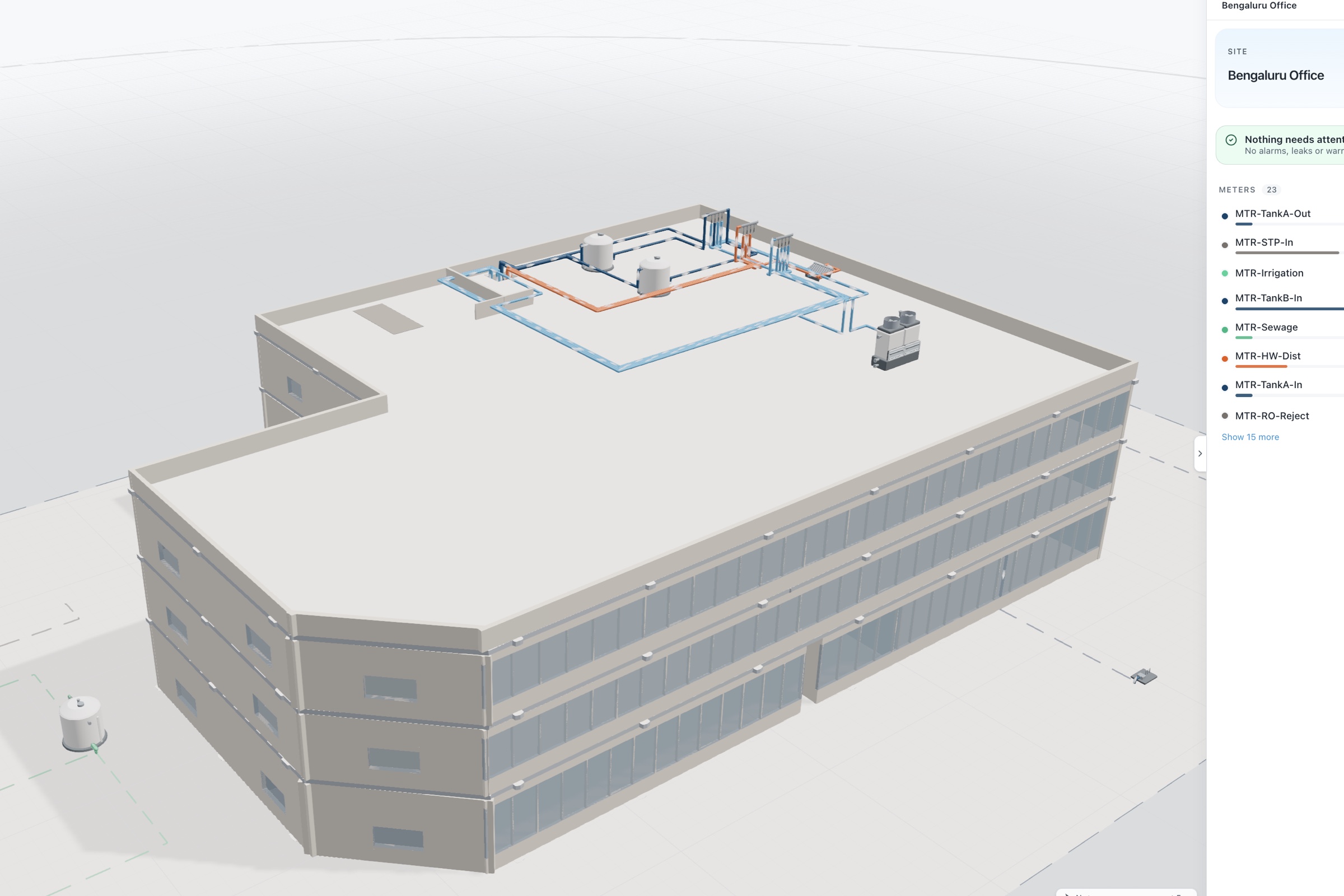
Aqueduct gives commercial owners one view across every asset. aQ Core holds the site, floor, zone and device model, and Billing Management under it handles tenant billing from sub-meters, with a landlord seeing the whole shared meter and each tenant seeing only its own share. It also validates utility bills against metered data and separates whether a cost change came from usage or from a rate change.
aQ EnergySmart provides the electrical digital twin and weather-normalized baselines, and aQ WaterGuard covers cooling towers, restrooms and irrigation. Smart Controls trims after-hours HVAC and holds schedules through Modbus and BACnet field devices or LoRaWAN relays, where control is enabled, with owner approval, with every command logged. Aqueduct serves a commercial real estate developer with 20M+ sq ft.