The best building management system for airports: one view across terminals, airside and tenants
 Milvian AI teamFacilities and infrastructure intelligence

The best building management system for airports reads every terminal's BMS and SCADA, meters energy and water across a network that behaves like a small city, bills concession and airline tenants from sub-meters, detects leaks with a live water balance and follows passenger flows in its air quality. Where control is enabled with owner approval, it acts with lockouts and a full command history.
Why airports are a hard case for a BMS
An airport is not one building. It is terminals, concourses, piers, parking structures, cargo sheds, maintenance hangars, fire stations, central utility plants and an airfield, connected by utility networks that the airport often owns and operates itself. Water mains run for miles under aprons and roads. Electricity is distributed across substations to dozens of buildings and to airline and concession tenants.
Inside the terminals, demand follows the flight schedule rather than the clock. Gates fill and empty in waves, security halls queue up at peaks, and baggage systems, jet bridges, preconditioned air units and ground power run in step with aircraft movements. Large glazed halls create heavy cooling loads in some climates and heating loads in others.
Most airports have grown by phases, each with its own controls contractor. The result is several BMS front ends, SCADA on the water and power networks, a CMMS for maintenance and very little that ties them together. When water use doubles overnight, the first sign is often the bill.
Then come the tenants. Airlines lease offices, lounges and maintenance space, concessions run kitchens and shops, and ground handlers run their own equipment. All of them consume electricity, water and conditioned air that the airport pays for first and recovers later, often from estimates. Disputes over those recharges are common because nobody has measured data both sides trust.
An airport also cannot afford downtime. Baggage handling, jet bridges, terminal cooling and fire water must work every hour the airport is open, and many airports never close. Maintenance teams therefore care as much about equipment health as about efficiency.
What the best BMS for airports must do
| Requirement | Why it matters in airports | Question to ask a vendor |
|---|---|---|
| Read many BMS and SCADA systems | Terminals and networks come from different eras and contractors | Can you read all of our BMS and SCADA sources into one model |
| Network-scale water balance | Buried mains leak under aprons and roads where nobody sees them | How do you balance supply against metered use and show unaccounted loss |
| Tenant and airline billing | Concessions and airlines consume utilities the airport pays for | Can you bill each tenant from meters, with shared meters split by share |
| Flight-driven HVAC | Gate holdrooms and halls do not need conditioning when empty | Can occupancy or the schedule drive ventilation and conditioning where approved |
| Peak demand and power quality | Central plants and baggage systems create large peaks and reactive loads | Do you show peak demand and power factor by feeder |
| Equipment health for critical systems | Failures in baggage, jet bridges or plant disrupt operations | How do you detect drift and route it to our CMMS |
| Portfolio across buildings | Hangars, cargo and parking need comparing too | How do you rank buildings of very different types |
| Evidence for carbon and water reporting | Airports report carbon and water to boards and programs | What exports do you provide for our reporting |
The categories of tools airports compare
- Terminal BMSReliable HVAC control inside each terminal. Separate per contractor, limited metering, no network view.
- Utility SCADAStrong real-time control of pumps, substations and treatment. Not designed for building analytics or tenant billing.
- Airport operations systemsExcellent on flights, gates and resources. Rarely linked to the plant or the utility networks.
- CMMS and EAMEssential for assets and work orders across the airport. Records work rather than watching equipment.
- Utility billing servicesHandle tenant invoicing. Often run from manual reads or estimates.
- Facility intelligence platformsOne data layer across BMS, SCADA, meters and sensors, with water balance, tenant billing, baselines and governed control. Needs a metering survey across the networks.
How to evaluate an airport BMS or platform
- Map the networks and the metersList supply points, sub-meters, tenant meters and the BMS and SCADA systems in each building.
- Start with the water balanceCompare supply with metered use. Unaccounted loss tells you where to look first.
- Upload bills and tenant recordsBaselines from bills and a check of tenant recovery show early value with little hardware.
- Pilot one terminal and one network zoneMeasure HVAC against the flight schedule and water against the balance, with targets agreed up front.
- Scale across the airportRepeat the metering and reporting design for other terminals and support buildings.
Evaluation scorecard for airports
| Criterion | Weight | What good looks like |
|---|---|---|
| BMS and SCADA integration | High | Every system read into one site, floor and zone model |
| Water balance and leak detection | High | Supply balanced against use, unaccounted loss shown live |
| Tenant billing | High | Dedicated and shared meters, tenant views and anomaly flags |
| Energy baselines and peak demand | Medium | Weather-normalized baselines and feeder-level demand |
| Control governance | Medium | Approval, lockouts and command history |
| Security review | Medium | Clear segmentation and access control for airport IT |
Integration and data
Airports should keep their terminal BMS and SCADA and read them. BACnet and Modbus cover most building and plant equipment, and LoRaWAN meters extend coverage across car parks, cargo areas and long utility runs without trenching. The CMMS stays the system of record for maintenance and receives findings with evidence.
Security matters more here than almost anywhere. Ask how the platform connects to building networks, which systems it can write to and how commands are approved and logged. Read-only integration is a sensible first phase.
Phasing matters too. Most airports start with metering and the water balance, because they deliver results without touching any control system. Tenant billing follows, then baselines and fault detection on terminal plant. Control, where it is wanted at all, comes last, starting with low-risk spaces such as offices and car parks.
Compliance and reporting in airports
Many airports participate in the Airport Carbon Accreditation program run by Airports Council International, and report energy and emissions to boards and public owners. Water audits following the AWWA M36 method suit airports that operate their own distribution networks. Buildings may also fall under benchmarking, building performance standards, LEED or ISO 50001.
A platform supplies the measured consumption and loss figures these programs rely on. The airport and its auditors make the submissions.
Where Aqueduct fits
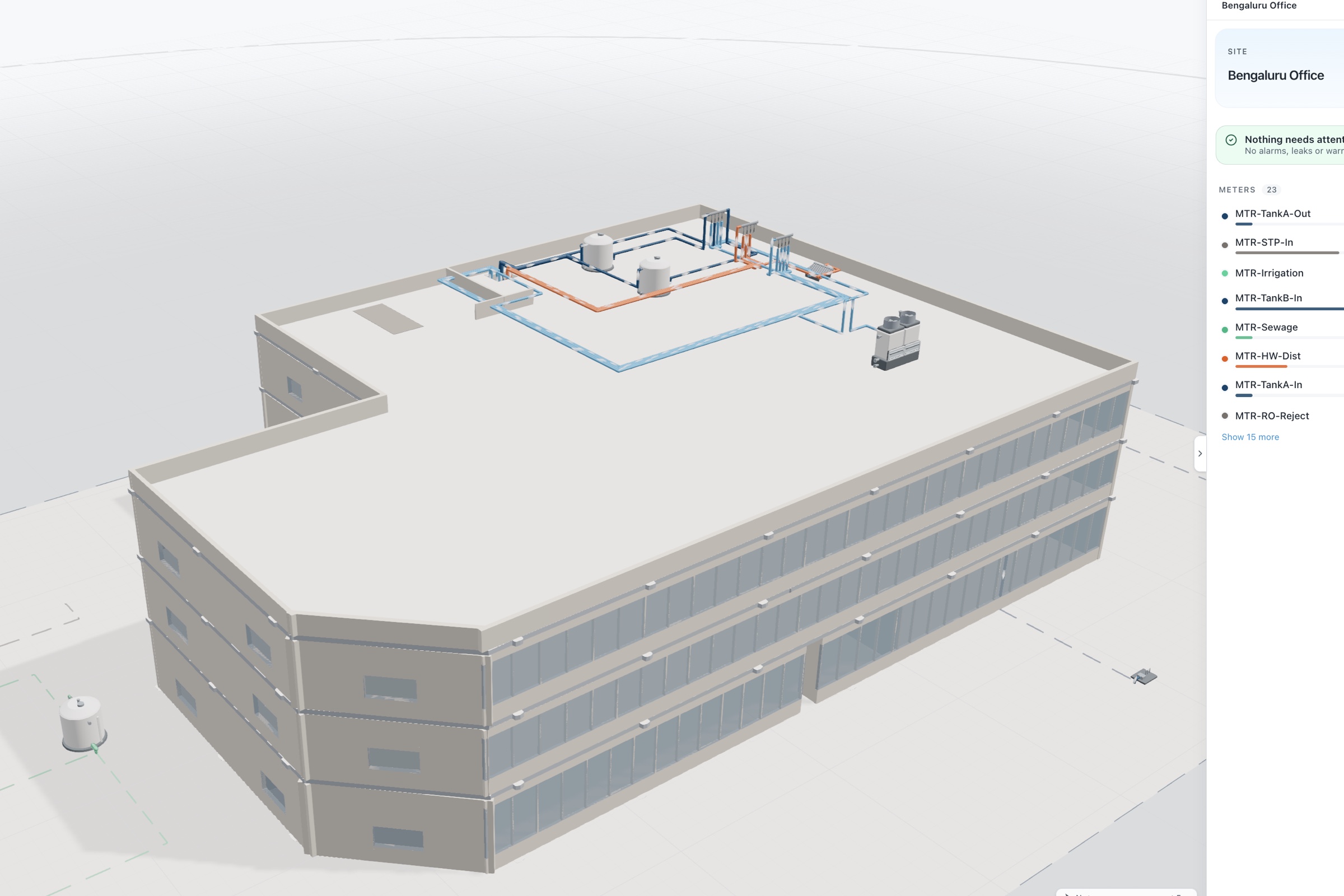
Aqueduct brings terminals, support buildings and utility networks into one model in aQ Core. aQ WaterGuard balances supply against metered use and shows unaccounted loss live, aQ EnergySmart baselines terminals and plants against weather with feeder-level demand, and aQ AirSafe follows passenger areas with CO2 and occupancy. Billing Management bills concession and airline tenants from their meters.
Smart Controls acts on HVAC and ventilation through Modbus and BACnet field devices or LoRaWAN relays, where control is enabled, with owner approval, with lockouts and a command history that shows what was sent and whether it ran. Findings route into the airport's CMMS with the evidence attached, so maintenance teams work from one list. Aqueduct serves a top 25 US airport.